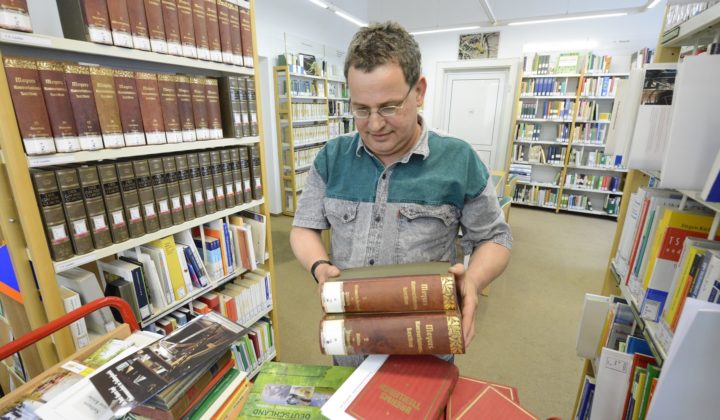
With a collection of approximately 153,000 items, the library at the Senckenberg Museum of Natural History in Görlitz is one of the largest specialized natural science libraries in Upper Lusatia. Its primary purpose is to provide scholarly literature to support the research work of the institute’s scientists.
In addition, the library is open to the general public. Readers have access to accessible literature in the fields of natural sciences and the history of the region.
The library collects, catalogs, and makes available written materials in the fields of zoology, soil zoology, botany, ecology, geology, and paleontology.
Other scientific and regional literature from Upper Lusatia is included in the collection to a limited extent.
Information
Tuesday 9 a.m.–5 p.m.
Thursday 9 a.m.–3 p.m.
Eligibility
Individuals aged 6 and older (children aged 6–13 may use the library only in the reading room or when accompanied by an adult)
Borrowing Eligibility
Individuals aged 14 and older with a valid form of identification (student ID, driver’s license, etc.)
Loan Period
Monographs: 4 weeks
Journals: 2 weeks
Loan Fees
Borrowing is free of charge. Late returns will incur fees for the user in accordance with the fee schedule.
Copying fees
€0.10 per page, €0.15 per sheet
Reference collection
The reference collection is specially marked and may only be used in the reading room.
Reading room
The reading room has 8 spacious reading stations (with power outlets for laptops), an OPAC workstation, and Wi-Fi.
OPAC
Users can independently search the library’s collection at a computer workstation.
Card catalogs
An alphabetical (AK), a subject (SYK), and a periodicals (ZK) catalog are available, as well as a card index for maps and special prints.
(maintained until 2023)
The library is a specialized academic library that primarily collects and provides access to scientific literature. Students, high school students, and interested members of the general public can also find valuable information here in books and journals.
The library houses several special collections, such as the “Creutz Collection” of ornithological literature, the “Jordan Collection” of literature on bugs, and the “Scheffel Collection” of literature on butterflies.
The library’s classification system includes the following main categories:
1. General
2. Law
3. Language Dictionaries
4. Mathematics
5. Physics
6. Chemistry
7. Astronomy, Meteorology
8. Series and Collections
9. Biographies
10. Biology
11. Phylogenetics, Genetics
12. Ecology
13. Microbiology
14. Mycology
15. Botany
16. Zoology
17. Geology, Mineralogy, Paleontology
18. Agriculture, Forestry, Hunting, Inland Fisheries
19. Nature Conservation and Environmental Protection
20. Geography
21. Museology
The entire collection is divided into a main collection, housed in the library building, and the workstation collections of the section heads.
Collection
Monographs 25,000
Journals (volumes) 94,700
Maps 1,350
Audiovisual materials 5,200
Publications of the Görlitz Natural History Society 260
Offprints (not yet entered into the database) 25,800
Total items (approx.) 153,000
(As of March 2019)
Here you can search the library’s collection and check the availability of the materials you’re looking for!
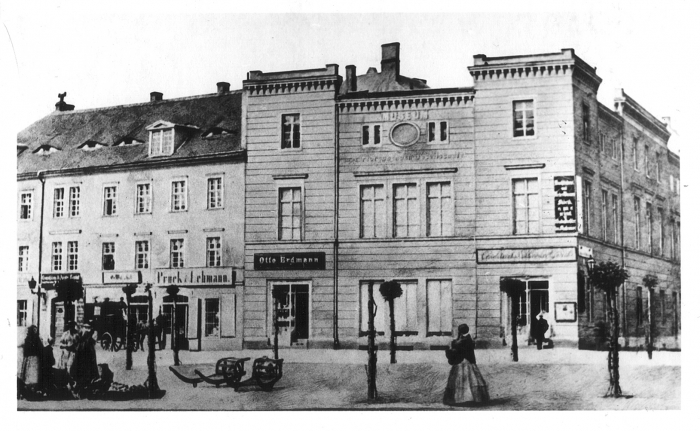
The library’s development is closely linked to the history of the Görlitz Society for Natural History, founded in 1811. The book collection was initially built up through donations, just like the collections of bird specimens, plants, minerals, and so on, and grew steadily. The Society therefore stipulated in its bylaws in 1827 that it was necessary to establish a library. This took place in 1830, when a librarian was appointed for the first time to manage all the publications.
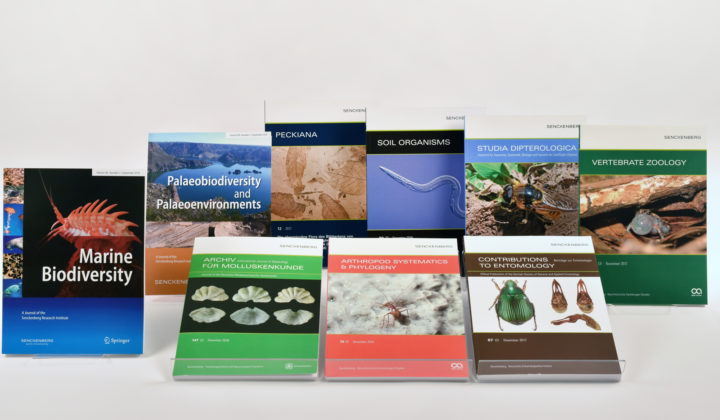
With 434 volumes, the systematic use and expansion of the collection began that year, and it has since grown to approximately 151,000 items. A key factor in this expansion was the exchange of publications, which has developed since 1836 with the publication of the second volume of the “Abhandlungen der Naturforschenden Gesellschaft zu Görlitz” (Proceedings of the Natural History Society of Görlitz), known since 2008 as “Soil Organisms.” Today, the Senckenberg Museum of Natural History in Görlitz also publishes the series “ACARI” and “Peckiana.” The library distributes these three publications, along with the “Reports of the Natural History Society of Upper Lusatia,” through a journal exchange to over 300 partners worldwide.
For a long time, the Natural History Society neglected the library. It often lacked the financial resources to make important acquisitions. For example, Julius von Zittwitz (president of the Society from 1861 to 1867 and from 1869 to 1873) faithfully copied the entire set of plates from a masterfully illustrated ornithological work by G. R. Gray, featuring 800 vibrantly colored illustrations of rare birds. The drawings are still in the library’s possession today. Extensive bequests and donations from members and friends of the Society also contributed to the expansion of the collection.
As early as 1842, the library’s collection numbered 2,084 volumes. Beginning in December 1866, the duties of the librarian were assumed by the Cabinet Inspector and later Director, Dr. R. Peck. From that time on, the care of the library became one of the responsibilities of the respective curator or museum director.
Starting in 1836, there were so-called library and reading hours for the Society’s members. In the summer semester of 1882, the library opened its doors to the public for the first time on Wednesday afternoons; in 1904, Saturday afternoons were added as a second opening day.
After World War I, H. von Rabenau took over the library and implemented a reorganization, resulting in a more systematic arrangement of the books and journals. The collection had grown to 30,000 volumes.
The library suffered no losses during World War II. After the museum came under the administration of the State Secretariat for Higher and Technical Education of the GDR in 1953, the library also received funding to expand its collection, particularly for literature relevant to the museum’s research focus. This laid the foundation for the current collection in terms of its composition (see Profile) and size (see Statistics).
In 1967, a trained librarian began working at the library for the first time. For many years, the collections were housed in extremely cramped quarters within the main building; large portions of the periodicals were even stored off-site. This situation improved in 1995 with the library’s move to the newly reconstructed building at Museum 2.
The merger of the State Museum of Natural History in Görlitz with the Senckenberg Research Institute and Natural History Museum in 2009 also opened up new prospects for the library. This made it possible to fill a full-time position with two staff members. A constructive collaboration is developing among all libraries in the Senckenberg network, with the goal, among other things, of presenting the entire collection (over 1 million media items) in a web-based OPAC.
The library of the Senckenberg Museum of Natural History in Görlitz is offering the following journals and series for exchange:
Research institutes, museums, libraries, and publishers wishing to exchange their own publications on biological and geological topics for these (Senckenberg) publications should contact:
Senckenberg Museum of Natural History Görlitz
Library
P.O. Box 300 154
02806 Görlitz
Germany